Who is At Fault in a T-Bone Car Accident?

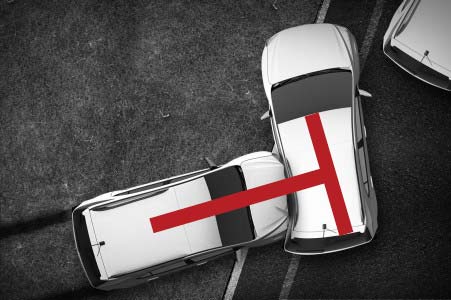
A T-bone car accident, also called a side-impact or broadside collision, happens when the front of one vehicle strikes the side of another, forming the shape of the letter “T.” T-bone crashes are among the most dangerous crash types, because only a door and window separate the people inside from the striking vehicle. A window can shatter on impact, and the door can collapse into the passenger compartment. The driver who hits the other car isn’t always the one at fault, because fault in a T-bone crash usually turns on who had the right-of-way.
Anyone hurt in a T-bone collision should get medical care first, even when injuries seem minor. Then consider talking with an experienced personal injury lawyer about the claim, because fault in these crashes is often disputed.
Who Is at Fault in a T-Bone Car Accident?
Fault in a T-bone car accident usually falls on the driver who failed to yield the right-of-way. A driver who runs a red light violates Texas Transportation Code § 544.007, and a driver who runs a stop sign or fails to yield at an intersection violates § 545.151. A driver turning left must yield to oncoming traffic under § 545.152, and a left-turning driver who cuts across oncoming traffic can be struck in the side. The striking driver is at fault in some crashes, and the struck driver is at fault in others.
More than one driver can share fault for a T-bone crash. Picture an intersection with stop signs, where Driver A rolls through the stop sign and Driver B, who has the right-of-way, is looking at a phone. Driver A is mainly at fault, but a jury could assign some responsibility to Driver B for failing to keep a proper lookout. Texas follows proportionate responsibility under Civil Practice and Remedies Code Chapter 33. A driver found 50 percent or less responsible can still recover, but the award is reduced by that percentage, and a driver found more than 50 percent responsible recovers nothing.
A third party can also share fault. A broken traffic signal, a sign blocked by overgrown trees, or a defective brake system can contribute to a T-bone crash.
Determining Which Driver Is at Fault in a T-Bone Accident

Determining which driver is at fault in a T-bone accident depends on evidence of who had the right-of-way. The most useful evidence includes photos of both vehicles and the intersection, statements from independent witnesses, the police crash report, and video from dashcams or nearby businesses. Texas traffic cameras don’t record, so business and home security cameras are often the best source of video. Take photos of the damage to both vehicles from several angles right after the crash, because the location and angle of the damage help show how the crash happened.
The police crash report records the officer’s observations, the drivers’ statements, and the contributing factors. An officer who investigates a crash with injury, death, or at least $1,000 in apparent damage must file the report within 10 days under Transportation Code § 550.062. Copies of Houston Police Department reports can be ordered through the Texas Department of Transportation or the city.
The officer may not decide who was at fault, and the report can contain mistakes. Witnesses may remember the crash differently, and the other driver may blame you. An experienced Houston car accident lawyer can gather the evidence, such as video and witness statements, needed to show who had the right-of-way.
Share this article:
Related Articles

Who Is Responsible for a Tire Blowout Accident in Texas?
Houston Police Department (HPD) Accident Reports
