





Graham E. Sutliff
Co-Founder
Always Available, Serving 24/7
(713) 987-7111A Houston Truck Accident Attorney delivers clear benefits for claimants. A Houston truck accident attorney is a legal representative with trial experience and a deep understanding of Texas regulatory frameworks. Sutliff & Stout delivers a significant advantage in Houston truck accident representation through extensive trial experience and a detailed knowledge of Texas Commercial Motor Vehicle regulations. Their attorneys gather critical evidence such as Crash Records Information System (CRIS) reports, subpoena driver logs and maintenance documents, and manage conversations with reconstruction experts and medical specialists. The approach ensures thorough assessment of liability and damages under Texas Transportation Code § 550 and Federal Motor Carrier Safety Administration (FMCSA) standards. Truck accident lawyers gather medical documentation, income verifications, and vocational assessments to support full compensation for current and future losses. The combination of local court experience, expert coordination, and statutory knowledge substantially reinforces settlement leverage and safeguards client recovery.
The benefits of hiring a Houston Truck Accident Attorney are listed below.
Our highly experienced lawyers will contact you for a Free Legal Consultation.
Collaborating with Sutliff & Stout truck accident attorneys in Houston offers numerous benefits, perks, and advantages for collision victims seeking legal representation.
Sutliff & Stout, Injury & Accident Law Firm has earned a reputation as one of the leading firms in Houston and the surrounding areas. Personal injury litigation has been practiced for more than 50 years by the Sutliff & Stout firm, which is headed by Hank Stout and Graham E. Sutliff. The firm has achieved $1 billion in accident-related verdicts for Houston citizens and has strategic offices throughout Texas. They have been helping thousands of injured Texans get just compensation since 2007 and are board-certified in Personal Injury Trial Law.
Working with Sutliff & Stout truck accident lawyers in Houston offers many benefits, such as experienced advocacy, proven track record, local presence and reputation, no upfront fees, and comprehensive support. Firm responsiveness and empathetic client services fosters confidence, increasing the chances of favorable outcomes and providing clarity throughout the recovery and settlement negotiation phases.
The advantages of working with Sutliff & Stout truck accident lawyers in Houston are listed below.
Experienced Advocacy
Sutliff & Stout possess decades of combined experience, with founding attorneys being Board Certified in Personal Injury Trial Law. Their credentials show their expert knowledge and specialization, allowing them to navigate complex truck accident cases effectively. Their deep understanding helps in addressing the unique regulations and challenges involved in truck accident claims, ensuring clients receive skilled representation.
Proven Track Record
The firm has secured over $1 billion in accident-related verdicts and settlements, reflecting its ability to achieve substantial compensation for its clients. Their history of handling high-stakes cases and winning important awards demonstrates their commitment and effectiveness in litigation and negotiation. The success provides clients with confidence that their case is in capable hands.
Local Presence and Reputation
Sutliff & Stout provides personalized service backed by trusted client reviews and top ratings with strategic locations across Texas and a well-established reputation in the Houston community. Their familiarity with Houston’s legal environment, judges, and insurance companies gives clients a distinct advantage in pursuing their claims efficiently. The local expertise helps streamline case management and heightens the chances of favorable outcomes.
No Upfront Fees
The “no fee unless you win” policy removes financial barriers, allowing injured clients to pursue claims without immediate cost concerns. The policy reduces financial risk for injured victims and shows the firm’s confidence in securing compensation. The law firm’s caring and approachable method guarantees clients get personalized attention and transparent communication throughout their case.
Comprehensive Support
Sutliff & Stout undertakes thorough investigations, including reviewing accident reports, consulting experts, and collecting vital evidence (police records and witness statements). The firm handles communications with insurance companies and opposing parties, relieving clients of complex legal burdens. Their proactive management ensures cases are well-prepared for settlement discussions or court trials, maximizing potential recovery.
For most cases, Texas has a 2-year statute of limitations. Every day you wait could cost you thousands in compensation.
The types of damages listed below are illustrative examples based on compensation amounts juries have awarded in personal injury cases across Texas. These figures are intended to provide general guidance,not guarantees or predictions, as each case is unique and compensation depends on specific circumstances.
There is no fixed compensation range or mathematical formula that can accurately predict the amount you may recover. For this reason, juries are instructed to consider the specific facts of the case, the harm suffered, and the financial and personal losses sustained before awarding damages.
While these examples may help illustrate the range of potential outcomes, your case will be judged on its own merits. Personal injury damages are highly individualized, similar injuries can result in different awards depending on how they impact each person’s life, work, and overall well-being.
For most cases, Texas has a 2-year statute of limitations. Every day you wait could cost you thousands in compensation.
Medical expenses in a truck accident case cover the costs of care (ambulance fees, ER visits, diagnostic scans, and emergency surgeries) needed after the collision. The damages include immediate and ongoing medical treatment, such as hospitalization and surgery costs, rehabilitation and physical therapy, doctor’s appointments, medication, medical devices, and other injury-related treatment costs. These damages are calculated based on hospital invoices in Houston, physician reports, and treatment records to ensure full reimbursement in a lawsuit, claim, or settlement. Attorneys use Truck Accident Medical Compensation as a foundation to build stronger claims that include ongoing treatment and future rehabilitation costs. Quick legal action ensures the expenses are documented and pursued before insurers dispute liability.
Common injuries in Houston truck accidents are listed below.
TBIs significantly increase claim value due to long-term medical costs, diminished earning capacity, and reduced quality of life.
Defense teams dispute causation or minimize injury severity by citing pre-existing conditions or alternative explanations for symptoms.
Establishing a direct link between the truck accident and brain injury requires extensive medical documentation and expert testimony to overcome insurer disputes and maximize compensation.
Don't let insurance companies minimize your traumatic brain injuries (TBI) claim. Our Houston attorneys know how to maximize compensation.
Truck Accident Statistics in Houston highlights the occurrence and severity of collisions involving commercial trucks and illustrates the need for improved safety and legal opportunities. Crash Reports show Houston had about 17 truck accidents daily, totaling 6,100 crashes. There were 40 deaths and 149 serious injuries reported, with truck accidents contributing to these outcomes.
| Category | Statistic (Houston 2023) |
| Daily Accidents | Approximately 17 per day |
| Injury Accidents | 149 serious injuries |
| Total Accidents | Approximately 6,100 |
| Fatalities | 40 |
| Attribute | Value |
| Population | Over 7 million |
| Risk Level | Very high |
| Truck Accidents | Approximately 6,200 |
| Fatalities | 97 per year |
| Avg Settlement | $500,000 to $3,000,000+ |
| Attribute | Value |
| Population | Over 5 million |
| Risk Level | Very High |
| Truck Accidents | Approximately 6,200 |
| Fatalities | 533 per year |
| Avg Settlement | Approximately $300,000 to $1,000,000+ |
| Attribute | Value |
| Population | Approximately 84,000 |
| Risk Level | Elevated (moderate to high) |
| Truck Accidents | 6,203 in 2023 |
| Fatalities | Approximately 120 per year |
| Avg Settlement | Approximately $8,000 to $10,000,000+ |
| Attribute | Value |
| Population | Approximately 2.31 million |
| Risk Level | Elevated |
| Truck Accidents | Approximately 6,200 in 2023 |
| Fatalities | 41 in 2023 |
| Avg Settlement | Approximately $300,000 to $3,000,000 |
| Attribute | Value |
| Population | Approximately 300,000 |
| Risk Level | Moderate High |
| Truck Accidents | 6,200 in 2023 |
| Fatalities | 40 in 2023 |
| Avg Settlement | $300,000 to $1,000,000+ |
| Attribute | Value |
| Population | Approximately 35,130 |
| Risk Level | Moderate |
| Truck Accidents | 5,293 (2023) |
| Fatalities | 41 in 2023 |
| Avg Settlement | $4,197 to $4,320 in 2023 (eviction-related civil judgments only) |
| Attribute | Value |
| Population | Approximately 90,000 |
| Risk Level | Moderate to High |
| Truck Accidents | Not specified; 6,100 Houston (2023) |
| Fatalities | Not specified; 40 Houston (2023) |
| Avg Settlement | $100,000 to $3,000,000+ |
| Population | Approximately 50,000 |
| Risk Level | Moderate |
| Truck Accidents | Not specified; 6,100 Houston (2023) |
| Fatalities | Not specified; 40 Houston (2023) |
| Avg Settlement | $300,000 to $3,000,000+ |
| Population | Approximately 10,000 residents and 200,000 daily workers |
| Risk Level | Moderate to High |
| Truck Accidents | Not specified; 6,100 Houston (2023) |
| Fatalities | Not specified; 40 Houston (2023) |
| Avg Settlement | Approximately $93,000 to $300,000+ |
| Population | Approximately 13,000+ |
| Risk Level | Moderate |
| Truck Accidents | Not specified; 6,100 Houston (2023) |
| Fatalities | Not specified; 40 Houston (2023) |
| Avg Settlement | Approximately $113,000 to $300,000+ |
| Population | Approximately 33,000+ |
| Risk Level | Moderate |
| Truck Accidents | 5,293 in 2023 |
| Fatalities | Not specified; 40 Houston (2023) |
| Avg Settlement | Approximately $112,000 to $500,000+ |
| Population | Approximately 78,000+ |
| Risk Level | Moderate |
| Truck Accidents | Not specified; 6,100 Houston (2023) |
| Fatalities | Not specified; 40 Houston (2023) |
| Avg Settlement | Approximately $50,000 to $1,000,000+ |
| Population | Approximately 100,000+ |
| Risk Level | Moderate |
| Truck Accidents | Not specified; 6,100 Houston (2023) |
| Fatalities | Not specified; 40 Houston (2023) |
| Avg Settlement | Approximately $300,000 to $3,000,000+ |
| Population | Approximately 150,000 |
| Risk Level | Moderate |
| Truck Accidents | Not specified; 6,100 Houston (2023) |
| Fatalities | Not specified; 40 Houston (2023) |
| Avg Settlement | Approximately $100,000 to $3,000,000+ |
| Population | Approximately 124,000+ |
| Risk Level | Moderate |
| Truck Accidents | Not specified; 6,100 Houston (2023) |
| Fatalities | Not specified; 40 Houston (2023) |
| Avg Settlement | $80,000 to $500,000+ |
| Population | Approximately 65,000 |
| Risk Level | Moderate |
| Truck Accidents | Not specified; 6,100 Houston (2023) |
| Fatalities | Not specified; 40 Houston (2023) |
| Avg Settlement | $100,000 to $500,000+ |
| Population | 2,300,000+ |
| Risk Level | High |
| Truck Accidents | 1,400 in 2023 |
| Fatalities | Over 200 in 2023 |
| Avg Settlement | $100,000 to $500,000+ |
| Population | Approximately 2,300,000 |
| Risk Level | Moderate to High |
| Truck Accidents | Not specified; 6,100 Houston (2023) |
| Fatalities | Not specified; 40 Houston (2023) |
| Avg Settlement | $80,000 to $500,000+ |
| Population | Approximately 2,300,000 |
| Risk Level | High |
| Truck Accidents | 2,830 per year |
| Fatalities | 65 per year |
| Avg Settlement | $80,000 to $300,000+ |
| Population | Approximately 2,000,000+ |
| Risk Level | High |
| Truck Accidents | 1,750 per year |
| Fatalities | 30 per year |
| Avg Settlement | $100,000 to $300,000+ |
| Population | Approximately 23,000+ |
| Risk Level | Moderate to High |
| Truck Accidents | Not specified; 6,100 Houston (2023) |
| Fatalities | Not specified; 40 Houston (2023) |
| Avg Settlement | $100,000 to $300,000+ |
| Population | Approximately 55,000+ |
| Risk Level | Moderate to High |
| Truck Accidents | Not specified; 6,100 Houston (2023) |
| Fatalities | Not specified; 40 Houston (2023) |
| Avg Settlement | $100,000 to $300,000+ |
| Population | Approximately 57,000 |
| Risk Level | Moderate |
| Truck Accidents | Not specified; 40 Houston (2023) |
| Fatalities | Not specified; 40 Houston (2023) |
| Avg Settlement | $150,000 to $300,000+ |
| Population | Approximately 75,000 |
| Risk Level | Moderate |
| Truck Accidents | Not specified; 6,100 Houston (2023) |
| Fatalities | Not specified; 40 Houston (2023) |
| Avg Settlement | $20,000 to $1,000,000+ |
| Population | Approximately 75,000 |
| Risk Level | Moderate |
| Truck Accidents | Not specified; 6,100 Houston (2023) |
| Fatalities | Not specified; 40 Houston (2023) |
| Avg Settlement | $20,000 to $1,000,000+ |
An average of 12 to 17 truck accidents occurs in Houston per day, highlighting the city’s role as a major transportation hub for commercial vehicles. Harris County, Houston, reported over 6,200 commercial vehicle crashes, the highest in Texas (2023). The report reflects Houston’s industrial focus on petrochemicals and product distribution, with heavy trucks on highways. Houston had 48 truck-related deaths in 2022, the deadliest in over 20 years.
Demographic data show that young drivers aged 16-25 contribute to numerous truck accident victims, despite being a smaller percentage of licensed drivers. Male drivers are responsible for over 70% of these accidents, mirroring their dominance in the trucking business. Residents of low-income or rural areas experience higher injury and fatality rates because of slow responses and restricted access to emergency services. The patterns show that socio-economic status, age, and gender affect the risk and effects of truck accidents in Houston.
The high truck accident rate in Houston results from multiple factors. Driver fatigue from long hours and tight schedules impairs attention, while distractions like using devices or adjusting systems divert focus. Speeding worsens crash severity, particularly in traffic or construction zones. Poorly loaded cargo causes instability, leading to jackknives or rollovers, and mechanical issues (brake failures and tire blowouts) stem from poor maintenance. Weather conditions (rain and slick roads) reduce visibility and traction, increasing hazards on Houston’s highways.
A Houston truck accident lawyer can help you avoid future accidents and legal pitfalls by thoroughly investigating the causes of an accident (equipment failure, driver error, or the trucking company’s negligence). The detailed examination brings attention to unsafe practices and regulatory violations that contribute to accidents. Lawyers hold responsible parties accountable through legal action, prompting changes in behavior and encouraging safer industry standards. It addresses the harm suffered by the victim and prevents the recurrence of similar accidents in the future.
A skilled truck accident lawyer educates clients about rights and responsibilities after a crash, aside from investigating and pursuing compensation. Lawyers provide guidance on important steps to take, such as immediately seeking medical care, preserving evidence, and avoiding premature settlement agreements that compromise legal claims. Houston truck accident lawyers protect clients from common pitfalls like accepting insufficient settlement offers or providing recorded statements that insurers might use against them. They manage communications with insurance companies and defendants. Their expertise ensures that legal deadlines and procedural requirements are met, reducing the risk of losing compensation opportunities due to technical errors.
Houston truck accident lawyers leverage their knowledge of federal and state regulations surrounding commercial trucking to secure favorable outcomes. The attorneys interpret complex safety laws and use violations of these rules as evidence of negligence, strengthening clients’ cases. Lawyers are prepared to take lawsuits to trial in cases where responsible parties resist accountability, demonstrating a commitment to justice that deters future misconduct. Attorneys help victims recover fully while encouraging safer roads and better industry compliance through their persistent advocacy and strategic legal approach, contributing to a reduction in truck-related accidents.
The three steps to take after a truck accident are listed below.
Types of truck accidents in Houston are listed below.
Settlement Range: $75,000 to $250,000 for moderate injuries and exceeding $1,000,000 to $4,500,000 for severe to wrongful death. Settlement amounts vary depending on accident details and severity of the injury.
Case Duration: At Sutliff & Stout, our average case duration is typically 14 months or less, while most firms take years.
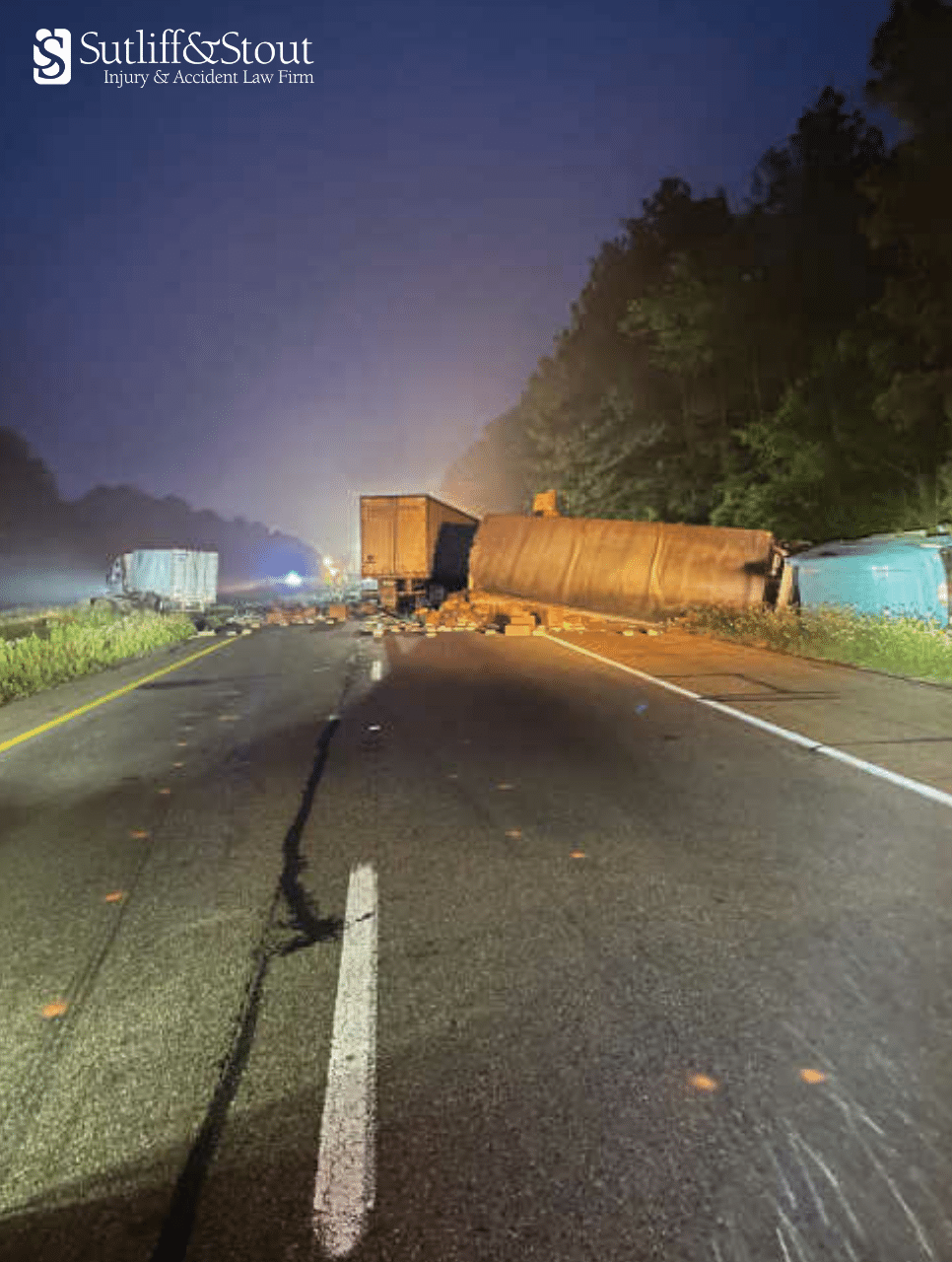
Jackknife accidents in Houston happen when a tractor-trailer’s cab and trailer bend inward at an acute angle, resembling a pocket knife or L-shape. Jackknife accidents cause multi-vehicle crashes that result in serious injuries or fatalities by blocking lanes. They make up around 3.5% of heavy truck crashes and are among the most dangerous truck accidents in the region. The common injuries include brain injuries, spinal damage, organ trauma, lacerations, and bruises from debris or blunt force. Settlement values depend on evidence, liability, and impact on victims’ lives, considering medical costs, lost income, and suffering. Victims face long-term disability, extensive medical care, rehab, and emotional support. Jackknife accident laws require proving negligence by the truck driver, trucking company, or responsible parties (maintenance providers or cargo loaders) for compensation. The comparative negligence rule allows damages if liability is no more than 50%, making investigation crucial to determine fault. Federal Motor Carrier Safety Administration (FMCSA) regulations and state laws oversee driver conduct, safety standards, and cargo securement to lower accident risks. Winning a legal case for a jackknife accident in Houston relies on proving negligence and gathering strong evidence like black box data, driver logs, maintenance records, and witness statements. A Skilled Jackknife Accidents Lawyer uses these to establish liability and counter defenses. Critical documents for jackknife accident cases include police reports, medical records, driver logs, maintenance records, cargo documentation, and black box data. The evidence helps establish circumstances, causation, and liability for compensation. Witness statements and photos of the scene support the claim, creating a comprehensive case package.
Common Causes:
Win Chances: At Sutliff & Stout we have a 99% success rate on all the cases that we take.
Settlement Range: $20,000 to $75,000 (minor injuries), $75,000 to $250,000 (moderate), up to $1,000,000 (severe), $750,000 to $5,000,000 (wrongful death).
Case Duration: At Sutliff & Stout, our average case duration is typically 14 months or less, while most firms take years.
Rollover truck accidents in Houston involve large trucks like tractor-trailers tipping over, creating dangerous road conditions. The crashes make up 18% to 30% of heavy truck accidents, causing serious injuries or fatalities. Data shows large truck rollovers lead to many injuries, with about 35% of restrained occupants suffering serious or fatal injuries. The crashes’ severity results from the truck’s weight and size, and instability during loss of control. Settlements for rollover truck accident cases vary based on injury severity and incident circumstances, depending on injury, medical costs, and lost wages. The common injuries include traumatic brain injuries (TBI), spinal cord damage, fractures, amputations, soft tissue and internal injuries, cuts, bruises, and paralysis. Houston truck law holds parties (drivers, trucking companies, cargo handlers, and maintenance crews) strictly liable for truck accidents, requiring proof of negligence. The plaintiff is entitled to damages if liability is divided, unless they bear more than 50% of the blame. Federal regulations oversee driver hours, maintenance, and cargo securement to prevent accidents (rollovers). Lawsuits must be filed within two years, stressing timely action. Winning a rollover truck accident lawsuit relies on building a strong case proving negligence and causation. A skilled Rollover accident attorney is necessary for navigating multi-party liability, negotiating with insurers, and pursuing litigation. Case histories show that thorough investigation and evidence presentation boost chances of success and fair compensation. Essential documents for rollover truck accident cases include police reports, medical records, driver employment records, Electronic Logging Devices (ELD) logs, vehicle maintenance logs, cargo loading docs, and data from the truck’s event data recorder or “black box.” Photos of the scene and damages, and witness statements, strengthen the case with factual evidence.
Common Causes:
Win Chances: At Sutliff & Stout we have a 99% success rate on all the cases that we take.
Settlement Range: $10,000 to $100,000 or more (moderate injuries), up to $1,000,000 and more (severe to wrongful death).
Case Duration: At Sutliff & Stout, our average case duration is typically 14 months or less, while most firms take years.
Rear-end truck crashes are a serious concern in Houston, accounting for about 44 percent of all vehicular crashes. There are 3.7 million incidents nationwide, and the severity of commercial vehicle crashes increases because they occur at high speeds. The crashes cause many injuries and fatalities each year. Injury profiles in rear‑end truck impacts include whiplash (cervical strain), thoracic injuries (rib fractures, internal organ contusions), concussion/TBI from sudden deceleration, and lumbar spine compression. The settlement value for rear-end collisions in Houston varies depending on the injury severity and the circumstances of each case. Truck occupants face risks of multiple injuries due to the nature of heavy vehicle crashes, which involve various effects and sources of harm, such as ejection or contact with the steering assembly. Winning a rear-end truck collision case in Houston depends on proving the driver’s or the company’s negligence. Houston trucking law favors injured parties when the rear driver causes the crash by not maintaining a safe distance or attention. Cases improve with clear evidence of fatigue, distraction, intoxication, or mechanical failure. A plaintiff must show less than 51% fault to recover damages under comparative negligence rules, and having experienced attorneys increases the chances of success. Legal cases for rear-end truck collisions in Houston last from months to years. Rear-End Collisions Lawyer settles cases in three to six months after medical treatments, but complex cases with serious injuries or disputes take over two years. Necessary documents for rear-end truck collision claims in Houston include police crash reports, photos, videos, medical records, witness statements, insurance info, and truck data.
Common Causes:
Win Chances: At Sutliff & Stout we have a 99% success rate on all the cases that we take.
Settlement Range: $75,000 to $250,000 (moderate injuries), $500,000 up to more than $1 million (wrongful death).
Case Duration: At Sutliff & Stout, our average case duration is typically 14 months or less, while most firms take years.
Head-on truck collisions in Houston are among the deadliest traffic accidents, causing many injuries and deaths. Houston had over 4,500 commercial truck crashes in 2023, about 12 daily, showing the high risk heavy trucks pose. The crashes happen on highways and undivided roads, where opposing traffic lanes are close, making impacts especially dangerous for smaller vehicles. Common injuries include traumatic brain injuries (TBIs), spinal cord injuries, broken bones, internal organ damage, and severe blunt force trauma. Settlement amounts for head-on truck collision cases vary depending on injury severity, fault, and the circumstances leading to the accident. The large settlements reflect the profound physical, emotional, and financial consequences borne by victims and their families. The laws governing head-on truck collisions in Texas, particularly in Houston, apply a modified comparative negligence rule, allowing injured parties to recover damages as long as fault is under 51%. Compensation decreases relative to the injured party’s degree of fault. Success in legal claims hinges on proving negligence by the truck driver or company, established through violations of federal and state regulations on driver conduct and vehicle maintenance. Cases of Head-On Collisions Attorney are influenced by injury complexity, case details, and the willingness of parties to settle. Essential documents necessary for legal action include police accident reports, medical records, witness statements, vehicle inspection reports, driver logs, black box data, and photographic evidence of the scene, all of which play critical roles in establishing liability and demonstrating damages.
Common Causes:
Win Chances: At Sutliff & Stout we have a 99% success rate on all the cases that we take.
Settlement Range: $75,000 and $250,000 (minor to moderate injuries), $500,000 up to more than $1 million (wrongful death).
Case Duration: At Sutliff & Stout, our average case duration is typically 14 months or less, while most firms take years.
Underride accidents in Houston, where smaller cars slide underneath large trucks, represent a hazardous and deadly category of truck crashes. Statistics show that accidents contribute to fatalities, resulting in approximately 21 deaths every year from crashes. National data reveal that underride collisions occur in about 38% of rear-end truck crashes, with a significant number leading to severe injuries or death due to the massive size difference between trucks and passenger vehicles. Common injuries include traumatic brain injuries (TBIs), spinal cord damage, paralysis, severe fractures, internal organ injuries, and deep lacerations. Houston has a high volume of commercial truck traffic, increasing the risks and frequency of underride incidents within the city, making them a critical safety concern for local roads and highways. Settlement values for accident cases show considerable variation according to injury severity and case complexity. The high settlement values represent compensation for long-term medical care, loss of income, pain and suffering, and other damages. Victims’ chances of winning a legal case, with the help of an Underride Accidents (Cars Sliding Under Trucks) Lawyer, increase when negligence by the truck driver, company, or equipment manufacturers is clearly demonstrated through evidence such as police reports, medical records, driver logs, vehicle maintenance documents, witness statements, black box data, and photographs of the accident scene. The documents are essential to building a strong case, proving fault, and obtaining fair compensation for the significant physical, emotional, and financial damage caused by underride crashes.
Common Causes:
Win Chances: At Sutliff & Stout we have a 99% success rate on all the cases that we take.
Settlement Range: $80,000 to $500,000 or more (minor to severe injuries), $1,000,000 and more (wrongful death).
Case Duration: At Sutliff & Stout, our average case duration is typically 14 months or less, while most firms take years.
Override accidents in Houston involve large trucks hitting smaller vehicles, causing severe injuries and deaths. The crashes are common on highways(I-45 and the 610 Loop) due to high truck traffic. Common injuries include traumatic brain injury (TBI), spinal cord damage, paralysis, broken bones, internal bleeding, severe lacerations, and burns. The size and weight of trucks lead to catastrophic damage and tragic outcomes for vehicle occupants. Settlement amounts in override accidents vary based on injury severity and case specifics, including medical costs, long-term rehab, lost wages, and pain. Houston uses a modified comparative fault system, affecting compensation by fault percentages. Federal and state safety regulations require trucking companies to follow standards. Non-compliance bolsters lawsuits. Legal chances of winning the case improve when clear evidence demonstrates negligence by the truck driver, the trucking company, or equipment manufacturers. Key documents essential for building a strong case include the police accident report, medical records, truck driver logs, maintenance and inspection records, black box data, witness statements, and accident scene photographs. Thorough documentation and expert legal representation of the Override Accidents (Truck Running Over Smaller Vehicles) Attorney impacts the success and duration of the cases.
Common Causes:
Win Chances: At Sutliff & Stout we have a 99% success rate on all the cases that we take.
Settlement Range: starts at $20,000 (minor injuries) to $500,000 (severe), $1,000,000 and more (wrongful death).
Case Duration: At Sutliff & Stout, our average case duration is typically 14 months or less, while most firms take years.
Blind spot accidents involving trucks in Houston are a significant safety concern due to the large blind zones around commercial vehicles, where smaller cars become invisible to truck drivers. Harris County reported over 850 accidents involving commercial trucks in 2024, with approximately 35% attributed to blind spot issues, resulting in 42 fatalities and 215 serious injuries. High-traffic highways (I-45) have risks because of the volume of trucks and frequent lane changes, making accidents common and dangerous. Common injuries include traumatic brain injuries (TBI), spinal cord damage, paralysis, fractures, internal injuries, and severe lacerations. The statistics underline the severity and frequency of blind spot accidents in the Houston area. Settlement amounts consider medical expenses, lost wages, pain and suffering, and long-term rehabilitation needs. The legal frameworks require careful assessment of fault, with negligence by truck drivers or companies playing a critical role in establishing liability. The law holds truck drivers liable for negligent acts like ignoring blind spots or violating traffic laws. Trucking companies are liable for poor training, maintenance, or scheduling that causes fatigue. Success in legal cases depends on clear evidence presented by Blind Spot (No-Zone) Accidents Lawyer, such as accident reports, electronic logs, maintenance records, and witness testimony. Key documentation includes police reports, medical files, driver logs, vehicle inspection records, black box data, witness statements, and accident photos, critical for proving fault and damages.
Common Causes:
Win Chances: At Sutliff & Stout we have a 99% success rate on all the cases that we take.
Settlement Range: $75,000 to $250,000 (minor to moderate injuries), $250,000 to over $1,000,000 (severe to wrongful death).
Case Duration: At Sutliff & Stout, our average case duration is typically 14 months or less, while most firms take years.
Wide turn (squeeze play) accidents in Houston occur when large trucks, like 18-wheelers, make wide turns, particularly right turns. The trucks (70 to 80 feet long and weighing up to 80,000 pounds) need more space to turn safely. They swing left first when turning right, surprising other drivers who are attempting to pass on the right. Serious crashes occur when a car gets into the truck’s blind spot during a turn and is squeezed between the truck and the curb. Common injuries include whiplash, spinal cord injuries, traumatic brain injuries (TBI), broken bones, soft tissue injuries, and amputations or fatalities. Houston and Harris County have over 6,000 trucking accidents yearly, more involving wide turns, leading to high injury and fatality rates. Houston’s comparative negligence rules reduce or deny recovery based on fault. Proving negligence, breach of duty, and causation strengthens claims. Trucking companies may be liable for negligent hiring, training failures, or pressuring drivers to violate hours. Winning a legal case involving Wide Turn or Squeeze Play accidents in Houston depends on proving negligence and liability. Experienced lawyers use resources like accident reconstructionists, forensic analysts, and medical experts to build cases. The trucking company’s insurance impacts case results, too. The comparative fault rule means that if the claimant is over 50% responsible, recovery is barred, highlighting the need for strong legal representation. The litigation timeline involves evidence gathering, settlement negotiations, and trial preparations. Prompt action of Wide Turn or Squeeze Play Accidents Attorney is critical to preserve evidence, vehicle data, and to meet the statute of limitations deadlines, two years for personal injury claims and wrongful death. Essential documents for a Wide Turn or Squeeze Play truck accident case include personal IDs, incident details, trucking records, photos, police reports, witness statements, medical records, maintenance logs, driver training, black box data, cargo details, and possibly cell phone or dashcam footage.
Common Causes:
Win Chances: At Sutliff & Stout we have a 99% success rate on all the cases that we take.
Settlement Range: $50,000 to over $1,000,000, based on injury severity and case specifics.
Case Duration: At Sutliff & Stout, our average case duration is typically 14 months or less, while most firms take years.
Lost load or cargo spill accidents in Houston happen when trucks lose cargo, creating hazards for drivers. The incidents are common in area truck crashes, often involving unsecured cargo. They cause injuries, extensive cleanup, and traffic disruptions. The financial compensation associated with lost load or cargo spill accidents varies widely based on injury severity and case specifics. Common injuries include Traumatic Brain Injuries (TBIs), spinal cord damage, paralysis, broken bones, and severe lacerations. Cases involving catastrophic injuries or fatalities tend to push settlement values into the higher end of this range. Liability distribution among parties such as truck drivers, trucking companies, and cargo loaders influences compensation outcomes. Federal and state regulations mandate proper securement of cargo to prevent such incidents, and violations of the rules form a critical basis for legal claims, which a Lost Load or Cargo Spill Accidents Lawyer handles. The laws applicable to the accidents involve the federal guidelines from the Federal Motor Carrier Safety Administration, requiring secure cargo handling procedures, and Texas state laws addressing liability and negligence. Essential documents for claims include police reports, medical records, black box data, truck maintenance logs, and cargo manifests, which support establishing liability and damage extent.
Common Causes:
Win Chances: At Sutliff & Stout we have a 99% success rate on all the cases that we take.
Settlement Range: $20,000 to $500,000 (minor to severe injuries), over $1,000,000 (fatalities).
Case Duration: At Sutliff & Stout, our average case duration is typically 14 months or less, while most firms take years.
T-Bone or Side-Impact truck accidents in Houston represent a significant portion of serious collisions, occurring at intersections where another strikes the side of a vehicle. Data indicates that intersection-related crashes account for approximately 32% of all fatal crashes from 2017 to 2021, with many T-bone accidents falling under the category. Thousands of side-impact crashes are reported yearly in Harris County alone, highlighting the frequency and severity of the incidents. The accidents involve considerable force due to the mass and momentum of trucks, contributing to the high rates of fatalities and serious injuries (Traumatic Brain Injuries (TBIs), spinal cord damage, internal organ trauma). The financial value associated with T-Bone truck accident settlements varies based on injury severity and specific circumstances. The settlement reflects the considerable impact T-Bone accidents have on victims’ lives, involving long-term recovery and emotional distress. The laws permit victims of the accidents to seek compensation through personal injury claims, guided by comparative fault rules that assign responsibility proportionate to each party’s negligence. The legal success of a T-Bone or Side-Impact accident attorney depends on proving another party’s failure to yield the right of way, breach of traffic laws, or reckless behavior. Winning a case requires a thorough investigation with evidence (police reports, medical records, vehicle damage photos, and eyewitness testimony). Crucial documents required include official police accident reports, detailed medical records, photographs of injuries and vehicles, witness statements, traffic citations, and available video footage to establish liability and support claims.
Common Causes:
Win Chances: At Sutliff & Stout we have a 99% success rate on all the cases that we take.
Settlement Range: $20,000 to $75,000 (minor), $75,000 to $250,000 (moderate), $1,000,000 and up (severe to fatalities).
Case Duration: At Sutliff & Stout, our average case duration is typically 14 months or less, while most firms take years.
Tire blowout accidents involving trucks in Houston contribute to the area’s high large vehicle crash rates. Tire blowouts are responsible for a significant percentage of commercial vehicle incidents, ranging from 8,000 to 12,000 truck crashes in Texas each year. Houston and Texas see thousands of injuries and hundreds of deaths yearly in truck accidents, with tire blowouts being a key factor in more cases. Common injuries include Traumatic Brain Injuries (TBIs), spinal cord damage, paralysis, broken bones, and severe lacerations. Legal standards governing the accidents are based on federal and state regulations requiring proper truck maintenance, tire safety compliance, and driver qualifications. Houston legal firms with commercial truck accident expertise help obtain these documents. Texas uses comparative fault rules to adjust compensation based on fault. Plaintiffs with strong proof of negligence succeed, particularly in cases of improper maintenance or manufacturing defects. The duration of legal proceedings of Tire Blowout Accidents Lawyer in Houston depends on injury complexity, liable parties, evidence, and negotiations. The cases settle quickly when liability is clear and injuries are minor, but serious or disputed cases need longer litigation or trial prep. Legal steps are crucial to preserve key evidence (ELD data and surveillance footage). Key documents for tire blowout truck accident claims include police reports, medical records, maintenance logs, driver logs, electronic data recorders, photos, videos, witness statements, cargo manifests, insurance info, and inspection reports. Legal experts help gather these to build a case.
Common Causes:
Win Chances: At Sutliff & Stout we have a 99% success rate on all the cases that we take.
Settlement Range: $20,000 to $75,000 (minor injuries), $500,000 and up (moderate to severe), $1,000,000 and up (wrongful death).
Case Duration: At Sutliff & Stout, our average case duration is typically 14 months or less, while most firms take years.
Multi-vehicle truck pileups in Houston are common, with over 6,000 truck accidents annually on busy highways like I-10 and I-45. Harris County data shows many involve multiple vehicles, often caused by chain reactions. The prevalence of large trucks on congested roads raises safety concerns due to frequent, complex crashes. Common injuries include Traumatic Brain Injuries (TBIs), spinal cord injuries, fractures from crushing forces, whiplash, and internal organ damage. Settlements consider the medical expenses, lost wages, pain and suffering, and property damage. The involvement of multiple vehicles and parties complicates claims, influencing settlement amounts and litigation strategies. The laws governing accidents combine federal and state regulations. The Federal Motor Carrier Safety Administration enforces driver hours, vehicle maintenance, and safety standards, while Texas applies comparative negligence rules that allocate fault among parties involved. Successful legal claims of Multi-Vehicle Pileups Involving a Truck Attorney depend on proving negligence, which consists of gathering evidence such as police reports, witness statements, driver logs, maintenance records, and accident reconstruction data. The chance of winning hinges on a clear establishment of fault and compliance with legal standards. Essential documents include crash reports from law enforcement, medical records, insurance information, and vehicle maintenance logs, which are critical in building a strong and credible case.
Common Causes:
Win Chances: At Sutliff & Stout we have a 99% success rate on all the cases that we take.
Settlement Range: $20,000 to $75,000 (minor injuries), $250,000 to over $1,000,000 (severe), and more than $3,000,000 (wrongful death).
Case Duration: At Sutliff & Stout, our average case duration is typically 14 months or less, while most firms take years.
Brake failure accidents involving trucks in Houston are a safety concern because of their size, weight, and complex braking systems. Texas reports about 5,700 truck crashes yearly related to brake failure, part of over 35,000 commercial truck crashes annually. The serious incidents cause severe injuries or deaths as trucks lose stopping ability, resulting in collisions or jackknifing. Common injuries include broken bones, spinal injuries, Traumatic Brain Injuries (TBIs), and paralysis. The complexity of accidents requires careful negotiation and legal proceedings to obtain fair compensation. Legal regulations for brake failures include federal laws from FMCSA, which mandate strict maintenance and inspection for commercial trucks, and Texas laws imposing extra safety requirements. Trucking companies and drivers are responsible for proper brake care, with manufacturers and maintenance providers liable if defective parts or improper servicing cause failure. Fault must be proven with evidence (police reports, maintenance records, driver logs, and expert reconstructions). Winning a legal case for a brake failure truck accident in Houston hinges on proving negligence with sufficient evidence provided by a Brake Failure Accidents Lawyer. Success involves showing breach of duty, like neglecting brake maintenance or safety rules, backed by documentation and expert testimony. Key documents include police reports, medical records, maintenance logs, driver logs, witness statements, crash photos, black box data, and sometimes video footage, supporting a compensation claim.
Common Causes:
Win Chances: At Sutliff & Stout we have a 99% success rate on all the cases that we take.
Settlement Range: $100,000 to over $5 million (minor to fatalities).
Case Duration: At Sutliff & Stout, our average case duration is typically 14 months or less, while most firms take years.
Mechanical failure accidents involving trucks in Houston are a major cause of crashes, injuries, and deaths. Approximately 10% of 18-wheeler accidents result from issues (brake failures, tire blowouts, engine problems, steering, and transmission failures) due to poor maintenance. These hazards occur on busy highways such as I-45, I-10, and Beltway 8, where heavy truck and vehicle traffic collide. Thousands of truck-related injuries happen yearly in Houston, with severe crashes caused by mechanical failures, resulting in serious injuries or wrongful death. Settlement compensation includes damages for emergency medical care, ongoing treatment, rehabilitation, lost earning capacity, physical and emotional pain, loss of companionship, and funeral expenses in wrongful death cases. Insurance policies for commercial trucks carry high liability limits of $750,000 or more due to the potential for extensive damage in accidents. Trucking entities must follow strict maintenance, inspection, qualification, hours-of-service, and electronic logging standards. Liability can extend to drivers, companies, maintenance providers, manufacturers, or third-party repair contractors. The success of a Mechanical Failure Accidents Lawyer in cases depends on collecting evidence like accident reports, black box data, maintenance logs, witness statements, and expert testimony to prove negligence or violations. The essential documents needed are police and medical reports, maintenance logs, driver files, electronic logs, accident photos, witness contacts, and expert analyses.
Common Causes:
Win Chances: At Sutliff & Stout we have a 99% success rate on all the cases that we take.
Settlement Range: $25,000 (minor) to $5,000,000 or up (for severe to wrongful death).
Case Duration: At Sutliff & Stout, our average case duration is typically 14 months or less, while most firms take years.
Driver fatigue accidents involving trucks in Houston represent a safety concern, contributing to commercial vehicle crashes. Statistics show that approximately 13% of commercial vehicle drivers involved in crashes were fatigued. Driver fatigue contributes to accidents in Houston, with fatigue-related truck crashes resulting in different injuries and dozens of deaths every year. Common injuries include Traumatic Brain Injuries (TBIs), spinal cord injuries, broken bones, internal injuries, and severe lacerations. The accidents result in long-term disabilities or fatalities due to the heavy weight and force of large commercial trucks. Laws on driver fatigue in Houston are federal and state rules that limit driving hours and require rest for commercial truck drivers. Violations result in fines, license suspension, and liability in accidents. An experienced Driver Fatigue Accidents Lawyer familiar with trucking laws and investigation procedures boosts the chances of successful outcomes. The timeline depends on the case’s complexity, the number of parties involved, negotiation processes, and whether the claim proceeds to trial. Delays occur due to detailed investigations, gathering of comprehensive evidence, and legal strategy formulation. Required documents for driver fatigue truck accident claims in Houston include police reports, medical records, driver employment files, logbook data, truck maintenance records, witness statements, photos of the scene, and expert testimony from sleep disorder or accident reconstruction specialists.
Common Causes:
Win Chances: At Sutliff & Stout we have a 99% success rate on all the cases that we take.
Settlement Range: $80,000 to $125,000 (minor), $500,000 to $1,000,000 and up (moderate to severe), and $4,000,000 to $5,000,000 (fatalities).
Case Duration: At Sutliff & Stout, our average case duration is typically 14 months or less, while most firms take years.
Intoxicated driving accidents involving trucks in Houston remain a critical issue, contributing to a significant number of crashes resulting in injuries and fatalities. Data reveals that alcohol impairment plays a role in more than 37% of traffic fatalities in Texas, with the city of Houston accounting for a big portion of the incidents. Common injuries include Traumatic Brain Injuries (TBIs), spinal cord damage, broken bones, internal injuries, and extensive lacerations. Legal frameworks of an Intoxicated Driving Accidents Lawyer addressing intoxicated driving in Houston include stringent laws with heavy penalties for commercial truck drivers, such as criminal charges that carry fines, license suspensions, imprisonment, and mandatory alcohol education and strict blood alcohol content (BAC) limits for commercial drivers, enforced by the Texas Department of Transportation and Federal Motor Carrier Safety Administration (FMCSA), serve as key deterrents and improve roadway safety. Legal success in intoxicated driving truck accident cases depends on solid evidence like toxicology reports, BAC test results, police reports, witness statements, and expert testimony.
Common Causes:
Win Chances: At Sutliff & Stout we have a 99% success rate on all the cases that we take.
Settlement Range: $25,000 to $75,000 (minor to moderate injuries), $250,000 to over $1,000,000 (severe to wrongful death).
Case Duration: At Sutliff & Stout, our average case duration is typically 14 months or less, while most firms take years.
Distracted driving involving trucks in Houston causes many accidents, injuries, and deaths. Distracted driving has increased since early 2022. Houston recorded 75,711 total collisions, resulting in 323 fatalities and 1,592 serious injuries. A record of nearly 20 % of all crashes involved distraction, with 373 deaths and 2,587 serious injuries attributed to distracted drivers in Texas that year. Texting and handheld device use remain high among drivers on busy Houston highways with heavy truck traffic. Distracted driving truck accidents cause injuries like traumatic brain injuries, broken bones, spinal injuries, internal bleeding, and severe cuts, due to high-impact collisions when drivers aren’t attentive. Houston enforces laws banning texting and cellphone use for commercial drivers under federal and Texas regulations. The FMCSA prohibits texting and handheld device use for commercial drivers, and Texas bans all cellphone use while driving locally. Penalties include fines, license suspensions, and disqualification. Winning cases of Distracted Driving Accidents Lawyer relies on strong evidence such as accident reports, phone records, logs, black box data, witness statements, and expert testimony to prove negligence. The key documents include police reports, medical records, electronic logs, driver files, crash photos, witnesses, and experts to establish liability and get fair compensation.
Common Causes:
Win Chances: At Sutliff & Stout we have a 99% success rate on all the cases that we take.
Settlement Range: $50,000 to $150,000 (minor), $500,000 to over $1 million (severe to wrongful death), depending on medical costs, lost income, and liability evidence.
Case Duration: At Sutliff & Stout, our average case duration is typically 14 months or less, while most firms take years.
Weather-related truck accidents in Houston stem from a convergence of rainfall-slicked roadways, reduced visibility, and high-speed conditions that compromise vehicle control. TxDOT reports indicate rain factors into more than 85 percent of weather-related crashes across Texas. Adverse weather contributes to roughly 4.6 percent of freight traffic incidents, with about 12 percent of overall truck delays attributed to weather-related disruptions, which translates into increased crash risk. Victims of weather-related truck crashes in Houston tend to suffer from injuries such as whiplash, spinal trauma, broken ribs, internal bleeding, and traumatic brain injuries resulting from fishtailing, hydroplaning, or sudden loss of control. Texas law imposes a duty on drivers to operate vehicles under control and adjust for conditions, including reduced speed on wet roads and adherence to safe following distances. Liability under Texas Civil Practice & Remedies Code § 16.003 requires filing injury claims within 24 months of the incident, and cases hinge on weather reports, police crash data, and expert reconstruction findings. Essential documentation by the Weather Related Accidents Lawyer for the cases includes official CR-3 crash reports, meteorological data, maintenance logs, driver logs (ELD records), expert analysis, and medical records to substantiate causation and damages.
Common Causes:
Win Chances: At Sutliff & Stout we have a 99% success rate on all the cases that we take.
Settlement Range: $100,000 to $500,000 (moderate to severe injuries), Over $1,000,000 (fatalities), depending on injury severity and liability clarity.
Case Duration: At Sutliff & Stout, our average case duration is typically 14 months or less, while most firms take years.
Construction zone truck accidents in Houston arise from a convergence of human error, environmental factors, and regulatory breaches. Nearly 28,000 work-zone crashes occurred across Texas in 2024, resulting in 215 deaths and 825 serious injuries, with 81 percent of fatalities involving motorists or passengers. Jefferson County recorded the highest work-zone crash rates statewide. Severe injuries like spinal damage, traumatic brain injury, fractures, and internal bleeding often arise from sudden lane shifts, debris-laden roads, poor signage, or speeding. Texas’s “Move Over/Slow Down” law imposes fines up to $2,000 for speeding in work zones, while the “Move Over” mandate requires drivers to reduce speed by 20 mph when passing stationary maintenance vehicles. Winning litigation of a Construction Zone Accidents Lawyer requires clear proof of negligence via crash reports, work-zone layout maps, maintenance logs, and eyewitness accounts. Modified comparative-fault rules under Tex. Civ. Prac. & Rem. Code § 33.001 allows recovery if the injury claimant’s fault remains below 51 percent; settlements are likelier with solid evidence of driver breach of highway safety laws. Essential documentation includes CR-3 crash reports, site photographs, TxDOT work-zone plans, driver logs, vehicle inspection records, medical evaluations, and expert reconstruction findings. Strong case portfolios of reference, official work-zone statistics, and documentation of compliant signage, speed limits, and traffic control plans to demonstrate breach of duty by the trucking party.
Common Causes:
Win Chances: At Sutliff & Stout we have a 99% success rate on all the cases that we take.
Settlement Range: $500,000 to over $1,000,000 (severe to fatalities).
Case Duration: At Sutliff & Stout, our average case duration is typically 14 months or less, while most firms take years.
Bridge strikes and overheight collisions happen when oversized or improperly routed trucks hit overpasses or bridges. Texas averages 11 bridge strikes annually per corridor, before improvements (height detection systems and better signage). Victims suffer traumatic brain injury, spinal trauma, facial fractures, and deep lacerations from debris or sudden deceleration. The incidents are caused by poor pre-trip planning, reliance on inaccurate GPS, ignoring height signs, and unsecured cargo, raising the vehicle height. Commercial vehicles must follow posted height limits and plan routes for overheight loads. The litigation success of a Bridge Strike Lawyer depends on proving violations and negligence, particularly when route planning omissions are documented. Cases involving catastrophic harm or breach of route compliance protocols may escalate into multi‑million dollar verdicts, mirroring trends in other Texas jurisdictions. Under Texas’s modified comparative‑fault system, plaintiffs remain eligible for full recovery when fault remains under 51%, though compensation reduces proportionally to any assigned fault. Crucial documentation includes GPS records, route permits, loading manifests, maintenance logs, dashcam or bridge‑sensor footage, CR‑3 police crash reports, medical evaluations, and expert bridge‑clearance analysis to establish the causes and negligence.
Common Causes:
Win Chances: At Sutliff & Stout we have a 99% success rate on all the cases that we take.
The laws related to Houston truck accidents are shown in the table below.
A Houston truck accident attorney evaluates a settlement offer by guaranteeing that it is fair for both parties. The attorney checks how serious the injuries are by reviewing medical reports and costs for treatment and recovery. For example, broken bones or head injuries need extensive medical care and time off work, which raises the offer’s value. The attorney looks at lost wages and future medical costs to ensure these are included in the settlement amount.
The Houston truck accident lawyer investigates who is responsible for the accident, such as the truck driver or the trucking company. Insurance limits and how much money is to be paid are important in deciding if the offer is enough. The attorney compares the offer to what the victim needs for medical bills, lost income, pain, and suffering. The attorney suggests rejecting it and trying to get more money through negotiation or the court if the offer is too low. Experience matters when judging the offer because a skilled attorney knows how insurance companies work and won’t accept a low payout easily. Taking the case to court results in a better outcome than receiving a quick settlement. The attorney makes sure the settlement is fair and covers all the victim’s damages, so the client is protected and gets proper compensation.
Truck accident settlements work in Houston through a legal process where injured parties seek financial compensation from the at-fault party or parties to cover damages resulting from the accident. The process begins with filing a claim vs. the responsible party, the trucking company, or the truck driver’s insurance company. Settlements are intended to compensate for losses such as medical expenses, lost wages, property damage, and pain and suffering. Negotiations between the injured party’s attorney and the insurance company’s adjuster work toward reaching a fair agreement on the amount of money to be paid. The degree of injuries and the intricacy of the case are two elements that affect settlement amounts in truck accident lawsuits in Houston.
Higher compensation is the outcome of more severe injuries (fatalities or disability). Claims are supported by evidence, which establishes liability and damages (police reports, medical records, and expert testimony). Negotiation duration and settlement size are impacted by the complexity of situations with the parties involved. The offer is examined to ensure it compensates for damages after a settlement is reached. The injured party is not allowed to pursue the claims following the signing. Cases are settled out of court, and compensation requires a lawsuit or trial. The chance of a successful settlement is increased when a knowledgeable lawyer assists with negotiations, evidence collection, and rights protection.
No, Texas is a no-fault state for truck accidents. The person who caused the accident is responsible for damages, and the injured party must prove fault to get money for medical bills, repairs, and losses. Texas requires minimum insurance coverage of $30,000 for injury to one person, $60,000 for multiple persons, and $25,000 for property damage. Victims need more in court if damages exceed the said amounts. Texas adopts modified comparative negligence, which states that if the injured party is 51% or more at fault, they are not entitled to compensation. Each proportion of fault lowers compensation if both parties are at fault. Determining who is at fault is necessary for fair compensation because truck accidents are complicated.
Your rights if you were in a truck accident are listed below.
To understand whether you need a truck accident attorney, follow the seven steps listed below.
Evaluate case complexity
Determine if multiple vehicles, commercial trucking companies, or government entities are involved, as the situations require advanced legal strategies and knowledge of federal trucking regulations.
Assess injury severity
Consider the extent of physical injuries, long-term medical care, and potential disability, which affect claim valuation and litigation needs.
Review insurance challenges
Identify disputes with insurers, such as denied claims or low settlement offers, that signal the necessity for experienced legal intervention.
Examine liability issues
Analyze whether the fault is contested or shared between parties, which demands legal expertise to protect financial recovery under Texas comparative negligence laws
Check for regulatory violations
Investigate if federal trucking safety violations or driver log infractions are present, as proving the breaches strengthens liability claims.
Consider financial stakes
Recognize when potential damages include substantial medical bills, lost wages, and pain and suffering, increasing the need for skilled negotiation or trial representation.
Analyze evidence requirements
Evaluate the need for accident reconstruction, black box data retrieval, or expert testimony, all of which require attorney coordination.
The common causes of truck accidents in Houston are listed below.
Driver fatigue arises when commercial operators exceed Hours-of-Service (HOS) limits set by the Federal Motor Carrier Safety Regulations (FMCSR) under 49 CFR § 395.3, which restricts driving to 11 hours within 14 hours. Fatigue-related crashes involving large trucks account for approximately 13% of fatal truck collisions annually, according to TxDOT data. Legal claims for plaintiffs rely on demonstrating some breaches as negligence per se, while defendants counter by asserting compliance through logs or arguing unforeseeable circumstances. Key reports include electronic logging device (ELD) data, driver logbooks, dispatch communications, and toxicology screens. Observations such as erratic lane movements and extended periods without rest breaks further corroborate fatigue-related liability.

Speeding with a fully loaded truck increases stopping distances and magnifies collision forces, violating FMCSR § 392.6, which mandates safe speed adjustment for weight and road conditions. National Highway Traffic Safety Administration (NHTSA) data shows speeding as a factor in 23% of large truck fatalities nationwide, with Texas among the top five states for such incidents. Plaintiffs claiming damages may assert negligence based on recorded speeds exceeding limits, while defense arguments often include environmental factors or mechanical issues like brake fade. Evidence must consist of GPS records, black box data, witness testimony, and law enforcement speed assessments. Photographs of skid marks or damage patterns and post-crash vehicle inspections add strength to the causation argument.

Distracted driving involves activities diverting attention from the road, such as using in-cab electronics or GPS devices, which the Federal Motor Carrier Safety Administration (FMCSA) bans under 49 CFR § 392.80. Distraction accounts for approximately 5.3% of fatal truck crashes, according to FMCSA’s Large Truck Crash Causation Study. Claimants cite distraction as a direct breach of statutory duty from a legal perspective, while defense strategies involve challenging causation or disputing device use at the time. Critical documentation includes cell phone records, dashcam video, electronic communication logs, and driver statements. Roadway observations of abrupt maneuvers or a lack of braking further support claims of distracted operation.

Driving under the influence (DUI) of controlled substances violates Federal Motor Carrier Safety Regulations (FMCSR) Part 382 and Texas Penal Code § 49.04, which mandates a blood alcohol content (BAC) of less than 0.04% for commercial drivers. Federal Motor Carrier Safety Administration (FMCSA) statistics reveal that 3.6% of large truck drivers involved in fatal crashes tested positive for drugs or alcohol. Plaintiffs asserting negligence rely on law enforcement toxicology reports and prior DUI citations, while defendants argue testing errors or procedural lapses. Key evidence includes breathalyzer results, post-collision drug tests, dashcam footage, and officer field sobriety observations. Witness statements describing erratic driving pre-collision and accident reports enhance evidentiary strength.

Deficient maintenance of brakes or tires directly violates Federal Motor Carrier Safety Regulations, which impose strict requirements for pre-trip inspections and regular upkeep. Federal Motor Carrier Safety Administration (FMCSA) data highlights that brake problems contribute to 29% of large truck crashes nationwide. Plaintiffs strengthen their claims by citing violations of maintenance standards, while carriers may defend using service records or arguing intervening factors like road debris. Essential documents include maintenance logs, repair invoices, inspection checklists, and violation history from FMCSA’s Safety Measurement System. Photographs of worn tires, brake system failures, or citations issued during roadside inspections provide visual evidence supporting liability.

Inadequate training occurs when drivers lack proper instruction on vehicle handling, defensive driving, and compliance with federal safety rules, violating Federal Motor Carrier Safety Regulations (FMCSR) § 380 Subpart E. Federal Motor Carrier Safety Administration (FMCSA) data indicates that driver-related factors like inexperience contribute to 38% of large truck crashes nationwide. Plaintiffs argue negligence based on the employer’s failure to provide adequate training or certify competency, while defendants might present records proving completion of training programs. Critical evidence includes driver qualification files, training certifications, employer safety manuals, and testimony from safety trainers. Observations such as improper gear usage, missed safety procedures, and errors during maneuvers reinforce claims of insufficient training.

Overloading and improperly secured cargo breaches Federal Motor Carrier Safety Regulations (FMCSR) § 393.100-136, which requires adherence to weight limits and securement standards to prevent load shifts. The Texas Department of Transportation reports that cargo-related issues contribute to a significant percentage of commercial vehicle accidents on rural and urban roadways. Victims claim negligence per se when weight records and inspection reports prove overloading, while the defense argues unforeseen circumstances, such as cargo shifting despite proper securement. Evidence includes weigh station records, cargo manifests, load distribution charts, and photos of spilled or shifted cargo. Crash scene observations of debris, toppled goods, or damaged tie-down equipment further support liability.

Unbalanced loads cause instability in trucks, increasing rollover and jackknife risks, which FMCSR § 393.100–134 seeks to prevent through precise weight distribution requirements. National Transportation Safety Board data shows that unbalanced loads are a factor in approximately 4% of large truck rollovers. Legal claims frequently center on the carrier’s failure to inspect and ensure proper load balance, while the defense might highlight third-party loading company errors or driver evasive actions. Supporting evidence includes cargo diagrams, bills of lading, load securing equipment logs, and expert testimony on center-of-gravity shifts. Visual documentation of load displacement after a crash and pre-trip inspection reports reinforce the argument for negligence.

Aggressive lane changes involve abrupt or unsafe maneuvers that endanger surrounding traffic, violating Texas Transportation Code § 545.060 regarding safe lane use. Federal Motor Carrier Safety Administration (FMCSA) studies attribute aggressive driving behaviors, including lane weaving, to 6% of fatal truck collisions. Plaintiffs argue that sudden lane changes created unavoidable hazards, while defendants assert that evasive actions were required to avoid other road dangers. Evidence includes dashcam recordings, eyewitness accounts, police crash diagrams, and in-cab telematics data showing steering inputs. Observations of skid marks, collision points, and vehicle positions support reconstruction of the unsafe maneuver.

Failure to Check Blind Spots (No-Zones) occurs when truck drivers neglect mirror checks or side camera use, violating Federal Motor Carrier Safety Regulations (FMCSR) § 392.14 regarding heightened caution in hazardous conditions. Federal Motor Carrier Safety Administration (FMCSA) research links blind-spot negligence to nearly 14% of crashes involving large trucks and passenger vehicles. Plaintiffs assert driver inattention to surrounding traffic as negligence, while the defense argues that other vehicles lingered in No-Zones contrary to safety guidelines. Pertinent evidence includes dashcam videos, mirror configurations, driver statements, and expert analyses of visibility angles. Observations of impact locations on the truck’s sides or rear validate blind-spot-related liability.

Improper wide turns happen when truck drivers swing too far into adjacent lanes or fail to account for the length of the trailer, creating risks for nearby vehicles. Federal Motor Carrier Safety Administration (FMCSA) crash data associates wide-turn errors with approximately 7% of reported large truck collisions. Legal claims argue negligence under Texas Transportation Code § 545.060 for failure to maintain a single lane, while carriers defend by citing obstructed intersections or evasive maneuvers. Essential evidence includes traffic camera footage, intersection schematics, witness statements, and dashcam recordings showing lane encroachment. Observations of tire tracks over lane markers or damage to vehicles caught in a “squeeze play” reinforce claims of driver misjudgment.

Failure to yield occurs when a truck driver ignores traffic signals or right-of-way rules, violating Texas Transportation Code § 544.004. In urban Houston intersections, TxDOT reports show that failure to yield contributes to over 10% of multi-vehicle truck crashes annually. Plaintiffs establish negligence per se when police reports confirm signal violations, while the defense might argue malfunctioning lights or obstructed signage. Supporting evidence includes police citations, signal timing records, dashcam video, and crash scene photographs. Witness statements about the driver’s failure to stop or yield strengthen the liability argument.

Mechanical failures such as steering defects, coupling malfunctions, or suspension breakdowns account for about 10% of truck crashes, according to the Federal Motor Carrier Safety Administration (FMCSA) Large Truck Crash Causation Study. Federal Motor Carrier Safety Regulations (FMCSR) require regular inspections and maintenance of such systems, making lapses in compliance a strong basis for negligence claims. Carriers defend by showing compliance records or attributing failure to unforeseen component defects. Vital evidence includes maintenance logs, repair invoices, manufacturer recalls, and inspection reports. Observations of worn components, broken linkages, or post-crash mechanical evaluations provide technical proof for litigation.

Improper use of Jake brake in city zones happens when drivers apply engine brakes in restricted areas, creating loud noises and unexpected deceleration, which Texas cities sometimes ban through municipal ordinances. Improper use has been linked to rear-end collisions and road disruptions, while crash-specific statistics for Jake brake misuse are rare. Plaintiffs claim negligence where municipal codes prohibit Jake brakes, while the defense may argue necessity due to steep grades or emergencies. Evidence includes sound monitoring records, driver logs noting brake application, and dashcam footage showing abrupt slowdowns. Witness testimony about noise and deceleration helps establish a violation of local restrictions.

Tailgating or following too closely with vehicles violates Texas Transportation Code § 545.062, which requires maintaining an assured clear distance between vehicles. Federal Motor Carrier Safety Administration (FMCSA) data attributes about 5% of large truck crashes to inadequate following distance, particularly at highway speeds. Plaintiffs alleging rear-end collisions rely on this violation to establish negligence, while the defense argues that sudden stops by other drivers. Key evidence includes dashcam footage, brake application records, skid mark measurements, and telematics data showing distance and speed before impact. Observations of damage patterns consistent with rear-end forces validate tailgating claims.

Pre-trip inspections are mandated under Federal Motor Carrier Safety Regulations (FMCSR) § 396.13 to identify defects before operating commercial vehicles. Federal Motor Carrier Safety Administration (FMCSA) roadside inspection reports reveal frequent violations, with nearly 20% of inspected trucks placed out of service for critical defects. Negligence claims often cite the absence of inspection logs or documented deficiencies as a breach of duty, while carriers might argue that failures developed en route despite inspections. Essential evidence includes pre-trip inspection checklists, driver certifications, and mechanic reports. Crash scene observations of noticeable wear or missing safety devices provide additional support for the plaintiff’s arguments.

Weather-related driving negligence occurs when truck drivers fail to adjust speed or driving style for adverse conditions, violating Federal Motor Carrier Safety Regulations (FMCSR) § 392.14, which requires ‘extreme caution” during hazardous weather. The percentage of Texas highways that are prone to sudden weather shifts, and 16% of large truck crashes involve wet, icy, or windy conditions. Plaintiffs argue negligence based on excessive speed for conditions, while the defense might claim unavoidable hazards. Evidence includes weather service reports, traffic camera footage, dashcam data showing speed, and driver logs. Observations such as skid marks on wet pavement or loss of control corroborate claims tied to weather-related negligence.

Violating height, weight, or length limits involves exceeding legal dimensions set by Texas Transportation Code § 621.101 and Federal Motor Carrier Safety Regulations (FMCSR) weight limits, causing bridge strikes or roadway damage accidents. Federal Motor Carrier Safety Administration (FMCSA) enforcement data reveal thousands of annual violations nationally, with Texas among the top reporting states for oversized loads. Plaintiffs alleging the violations present weigh station records or citations to establish liability, while the defense cites special permits or inaccurate signage. Evidence includes permits, weigh station slips, carrier routing plans, and crash scene photos showing overheight impacts or jackknifed trailers. Observations of structural damage to bridges or roadways reinforce the oversized violation claim.

Brake fade on downhill grades occurs when repeated braking on steep grades overheats brake components, reducing their effectiveness and leading to runaway trucks. Federal Motor Carrier Safety Administration (FMCSA) reports attribute approximately 4% of large truck crashes to brake system failures, with brake fade cited as a contributing factor on mountainous or hilly routes. Plaintiffs can argue negligence if drivers ignored Federal Motor Carrier Safety Regulations (FMCSR) § 392.7 requirements for inspecting braking systems before entering steep descents, while the defense might point to mechanical failure outside of maintenance schedules. Essential evidence includes brake inspection logs, mechanic reports, electronic brake monitoring data, and black box readings of speed and brake usage. Observations of scorched brake drums or extended stopping distances at crash sites support claims of brake fade.

Improper merging or weaving involves unsafe lane changes or failing to yield space when entering traffic, violating Texas Transportation Code § 545.060, which requires maintaining a single lane and safe merging. Federal Motor Carrier Safety Administration (FMCSA) crash data shows that merging errors contribute to 8% of large truck collisions, particularly on congested Houston freeways. Plaintiffs allege driver recklessness or lack of situational awareness, while carriers defend by blaming blind spots or sudden traffic changes. Evidence includes dashcam footage, GPS records showing lane positioning, and witness statements about erratic vehicle behavior. Observations of collision points on the truck’s front or sides align with merging-related negligence claims.

The services that Houston truck accident lawyers offer include a full-scale evidentiary compilation process, obtaining Event Data Recorder (EDR) downloads, driver logbooks, vehicle maintenance records, licensing documentation, and spoliation letters, to preserve all relevant trucking-company records. Legal counsel examines CR‑3 crash reports, official law-enforcement data, medical records, and witness statements, while collaborating with reconstruction experts to establish fault under Federal Motor Carrier Safety Administration (FMCSA) regulations and the Texas Transportation Code.
Clients receive comprehensive damage analysis, with past and future medical expenses, lost earnings, vocational impairment, property damage, pain and suffering, mental anguish, and loss of consortium, structured in line with Texas’s comparative negligence laws and two-year filing deadline. Negotiation strategy includes targeted demand letter preparation and adjuster-level advocacy, with full litigation readiness including trial preparation, cross‑examination, and expert presentation for catastrophic injury or wrongful-death cases. Lawyers ensure compliance with procedural mandates, such as governmental claim notices under the Texas Tort Claims Act, and coordinate multidisciplinary expert involvement (life-care planners, economists, medical cost analysts) to substantiate long-term care models and punitive damages where gross negligence is evident.
Tort Law plays a role in truck accident cases in Houston by establishing the legal foundation for driver and carrier liability under Texas negligence doctrines. Texas Transportation Code § 550.062 mandates crash reporting when collisions result in injury, death, or over $1,000 in property damage, generating admissible roadway and impact data. Texas Civil Practice and Remedies Code § 16.003 imposes a strict two-year filing deadline for personal injury and wrongful death claims, critically influencing case timing. Proving negligence requires demonstration of duty, breach, causation, and damages, with recovery adjusted under modified comparative fault if the plaintiff’s responsibility remains under 51%. Tort law prescribes avenues for punitive awards when gross negligence, recklessness, or malice is evident, in cases involving fatigued or intoxicated trucking operators. Liability extends to employers via respondeat superior when drivers operate within their employment scope, while motor carriers face direct liability for violations of federal safety regulations. Judicial outcomes hinge on evidence from police crash reports, vehicle maintenance logs, electronic logs, and expert reconstruction. Effective assembly of the evidence improves recovery of medical expenses, lost wages, pain and suffering, and, where warranted, exemplary damages.
The legal rights that truck accident victims have in Houston are listed below.
The federal and state regulations that apply to truck drivers in Houston are listed below.
Vicarious liability applies in a Houston truck accident lawsuit if the accident occurred while working. The truck company and the driver share responsibility for the accident if the driver was doing their duties, such as driving the truck or delivering goods. The law relies on the idea that companies are responsible for the conduct of their employees while they are on the job. The truck company is not accountable if the driver was engaged in personal activities unrelated to work. Proof that the driver was affiliated with the business and operating in the course of their employment is necessary. Documentation (work schedules, truck maintenance logs, and safety infractions) aids in demonstrating if the company is accountable. The law in Houston helps injured people get better compensation, as trucking companies tend to have bigger insurance policies than individual drivers. Holding the company responsible encourages safer driving and better care of trucks. It helps victims get the money they need after a serious truck accident caused by a company driver.
Yes, a trucking company can be held liable for an independent contractor’s actions, but terms apply. Independent contractors control the trucks and work, but liability arises if the company exerts significant control, such as providing equipment, dictating routes, scheduling, or requiring specific procedures. Excessive control shows an employer-employee relationship, making the company responsible for negligence. Liability arises if the trucking company fails to maintain safe equipment or improperly trains or supervises the independent contractor, leading to accidents.
The company is responsible if it has control or involvement when contracts specify contractor independence. Laws in certain regions recognize that misusing the independent contractor label avoids responsibility. Federal rules require companies to have minimum insurance for contractors. Courts analyze factors like control and equipment ownership to determine true relationships. A trucking company is responsible for accidents, guaranteeing liability for victims when they don’t meet safety standards or exercise control.
A Commercial Driver’s License (CDL) violation is used in a truck accident lawsuit by serving as a critical element in proving negligence and liability. Failure to fulfill safety standards is demonstrated when a commercial truck driver violates CDL regulations (fatigue driving over allowed hours, driving while under the influence, or not having the required license). Courts and insurance companies use the infractions as evidence that the driver violated their obligations, which led to accidents.
Legal proceedings analyze specific CDL violations to determine fault. Liability increases because they lack proper qualifications if a driver lacks the correct CDL class or endorsements. The trucking company is accountable if it failed to verify the driver’s license or pressured them to bypass safety rules. A CDL violation impacts negotiations and court rulings by showing disregard for safety standards. Insurance adjusters use such violations to assess liability and prefer fair settlements to avoid lengthy litigation. Juries see CDL violations as strong fault evidence, increasing compensation for injuries, wages, and pain. OCDL violations establish responsibility and secure compensation in Houston truck accidents
FMCSA violations establish liability and negligence in Houston truck accident cases. FMCSA violations refer to breaches of safety regulations set by the Federal Motor Carrier Safety Administration (FMCSA), which govern commercial trucking operations in the United States. The violations include infractions (speeding, reckless driving, driving beyond allowed hours, improper vehicle maintenance, or failure to conduct required inspections). The FMCSA establishes the rules to promote highway safety and reduce accidents involving commercial motor vehicles. Violations are tracked through roadside inspections, crash investigations, and driver and carrier records, and they carry consequences ranging from fines to the suspension of a driver’s commercial driving privileges.
FMCSA infractions are essential in demonstrating responsibility and negligence in Houston truck accident lawsuits. Violations committed by a driver or trucking firm before or during an accident are indicative of risky behavior that contributed to the collision. Hours of service violations, which limit driving hours to avoid fatigue, are associated with accidents because weariness impairs reaction and judgment. Vehicle components that exhibit poor maintenance (tires or brakes) raise the risk of collisions. The infractions help legal teams in demonstrating that safety regulations were disregarded.
FMCSA infractions are essential in cases involving truck accidents. They help in determining the accountability of employers and drivers, particularly in cases of severe or recurring infractions. The infractions influence insurance discussions by drawing attention to negligence and bolstering claims for punitive penalties. FMCSA violations are at the heart of lawsuits concerning commercial vehicle crashes in Houston and are necessary to hold parties accountable.
Yes, multiple parties can be sued in a single truck accident case. The occurrence happens when different parties have caused or helped cause the accident. For example, the truck driver, the trucking company, the company that loaded the cargo, or the maker of the truck parts is responsible if their actions or carelessness led to the crash. Figuring out who is accountable requires collecting proof (police reports, witness stories, and truck maintenance records). The company is at fault if the driver was tired because the company did not follow the rules. The maker is responsible if the truck parts broke because of a defect. Each person or company is accountable for the part they played in causing the accident. Laws allow the blame to be shared among parties, so each pays for their part of the damage. It makes the case more complex, but a well-handled case helps the injured person get money for medical bills, lost work, and other harms. Having experience with the cases ensures the responsible parties are included and fair compensation is received.
You can find a reliable truck accident attorney near you by checking the regions listed below.
Houston, TX:
Sutliff & Stout’s main office in Houston is at 550 Post Oak Blvd., Suite 530, offering legal assistance for truck crash cases across Harris County. Truck accident attorneys handle cases involving unsafe passing, hit-and-run drivers, and collisions near downtown, Westheimer, and the Galleria area.
Austin, TX:
Sutliff & Stout helps injured truck drivers with legal issues from crashes on South Lamar and Congress Avenue. Their legal support includes filing injury claims for dooring incidents, distracted drivers, and unsafe road design.
Marble Falls, TX:
The firm, located at 100 Avenue H, Suite 201, helps residents after truck accidents. Its services focus on common crashes along US-281 and neighborhood intersections where driver negligence causes serious injuries.
San Angelo, TX:
Sutliff & Stout offers legal support for truck drivers injured in crashes near Sherwood Way or Knickerbocker Road. Truck accident lawyers help gather medical records, witness statements, and police reports for injury claims.
Cypress, TX:
Sutliff & Stout handles truck accident cases in Cypress. Lawyers help residents with filing claims related to unsafe turns, failure to yield, and residential road crashes.
You should bring the official police report, medical records from Houston hospitals, photos of the accident scene, and insurance correspondence to your first meeting with a Houston truck accident lawyer. Additional helpful documents include repair estimates, proof of lost wages from an employer based in Houston, and written communication with the trucking company or its insurer. Witness contact information and a personal written account of the crash are valuable if the wreck occurred near high-traffic areas (I-45 or Beltway 8). The materials help the truck accident attorney evaluate liability, injuries, and damages under Texas law. Having detailed records from local sources supports a stronger case during negotiations or litigation in Harris County courts.
The legal services that are included when hiring a truck accident attorney are listed below.
Yes, a Houston attorney offers 24/7 availability for truck and injury cases to assist victims after serious collisions. Law firms in Texas understand that truck accidents occur at varying hours and provide around-the-clock access through phone, live chat, or online consultations. Immediate contact allows legal teams to preserve crash evidence such as police reports, truck maintenance logs, dashcam footage, and witness accounts. Early involvement supports accurate injury documentation from emergency room records, hospital files, and surgeon notes. Quick legal access ensures that the injured party avoids errors when speaking to insurers and helps initiate claims under Texas personal injury laws without delay.
Yes, you can switch truck accident lawyers if you’re unhappy with your current one. Texas law does not restrict changing legal representation, and a new lawyer handles the transition, including notifying the previous attorney and requesting the case file. Poor communication, lack of progress, limited experience with truck accident claims, or disagreements over legal strategy are prominent reasons why clients switch attorneys. A different lawyer with a stronger track record in handling serious commercial vehicle collisions helps improve the legal process and settlement outcome. Legal fees are shared between attorneys based on work completed, and clients do not pay extra for changing representation.
Yes, your case is strong enough to contact a truck accident attorney in Houston if the crash involved serious injuries, vehicle damage, disputed liability, or a commercial trucking company. Texas law holds trucking companies and their drivers to strict safety regulations, and any violation (hours-of-service breaches, overloaded trailers, or lack of proper vehicle maintenance) forms the basis of a strong legal claim. Medical records showing injuries (fractures, head trauma, or spinal damage) add weight to the case, along with police reports and witness statements. Insurance companies in Texas regularly attempt to undervalue trucking claims or shift blame onto injured drivers, making legal representation valuable from the beginning. Truck accident attorneys in Houston familiar with Federal Motor Carrier Safety Regulations and state negligence laws investigate black box data, driver logs, and corporate safety records to determine fault and secure full compensation.
The best way to find a truck accident attorney in Houston is listed below.
Federal trucking regulations make commercial truck accidents legally different from car accidents. Truck collisions in Houston involve oversight from agencies like the Federal Motor Carrier Safety Administration, which imposes strict rules on driver hours, maintenance logs, and cargo limits. The federal rules create more legal layers, which increase liability exposure for drivers, trucking companies, and third-party contractors. The investigation of truck accidents by a truck accident attorney in Houston involves dispatch records, Global Positioning System (GPS) data, black box readings, and employer accountability. Houston attorneys handling truck accident cases must gather records from various sources to trace responsibility and determine how compliance failures contributed to the crash.
Our experienced attorneys are ready to help you recover the compensation you deserve. Contact any of our office locations to schedule your free consultation.